Science
Karen-Beth G. Scholthof and Debra A. Reid
Science is everywhere in our daily lives and evident in our material culture in ways we may not contemplate. An inclusive history of science for museums and historic sites can begin with an everyday object ranging from a bathroom toilet to beachwear or a battery-powered drone. The toilet becomes the catalyst to learn about water, sewage treatment, and the physics of the commode. The historic beach apparel welcomes conversations about sunscreen, insecticides, and ocean ecology. The drone encourages conversation about the chemistry of electricity and the physics of flight.[1] From this, the inclusive historian can interpret the histories, uses, and controversies associated with the object; then this object can be brought to the public for further observation, interpretation, and discussion to enrich community history through science.
Scientists and Humanists Working Together
Science and history influence all aspects of society. Exploring the sciences may be outside the comfort zone of many humanists, but the tools of historians can make science more accessible to wide audiences. By posing focused questions, the historian can get to the core of how science and scientists have interpreted our world. Historical questions about why and how science was performed can also unearth uncomfortable questions about the role of science in shaping social relations.
In 2018, the physicist Walter Massey urged scientists and humanists to engage the public in the crucial issues we face today and to communicate that science is not a fixed idea, but a vehicle of change, responding to new technology and challenges. Massey’s thinking was predicated on Charles Percy Snow’s influential 1961 essay The Two Cultures. Snow was curious about the “gulf of mutual incomprehension” between scientists and humanists, who misinterpreted each other’s interests. Snow maintained that this divide was harmful to humanity. Instead of division (sciences vs. humanities), we need to do the work of communication and interpretation together.[2]
Bethann Garramon Merkle, an expert in science communication and engagement, encourages us to examine the origin stories of scientific findings and to develop compelling narratives of science through historical interpretation at museums and historic sites.[3] Understanding more about science in our everyday lives provides an opportunity to appreciate human experiences and reflect on how we interpret our world. It is also important to learn why some work is considered “junk” science that disregards factual, experimental findings.[4]
Inclusive Interpretation of Science at History Museums and Historic Sites
Historians have an essential role in helping us reflect on, and critically frame, science of the past and present-day interpretations of science. The National Council for History Education’s “History’s Habits of Mind” advances the notion that “thinking historically” to interpret past discoveries “fosters the ability to make judgements about the present.”[5] The Council has specific examples of how to use critical thinking skills and prompts to interpret history. We suggest that these same prompts can be adapted for the historian to approach an ever-changing world of science and the role of science in society. In parallel, UNESCO’s “Futures Literacy” program takes an imagined future world and uses historical interpretation to help audiences understand how decisions today can influence future outcomes. It reaffirms the idea that change is possible—that we are not stuck pursuing a single pathway to the future.[6]
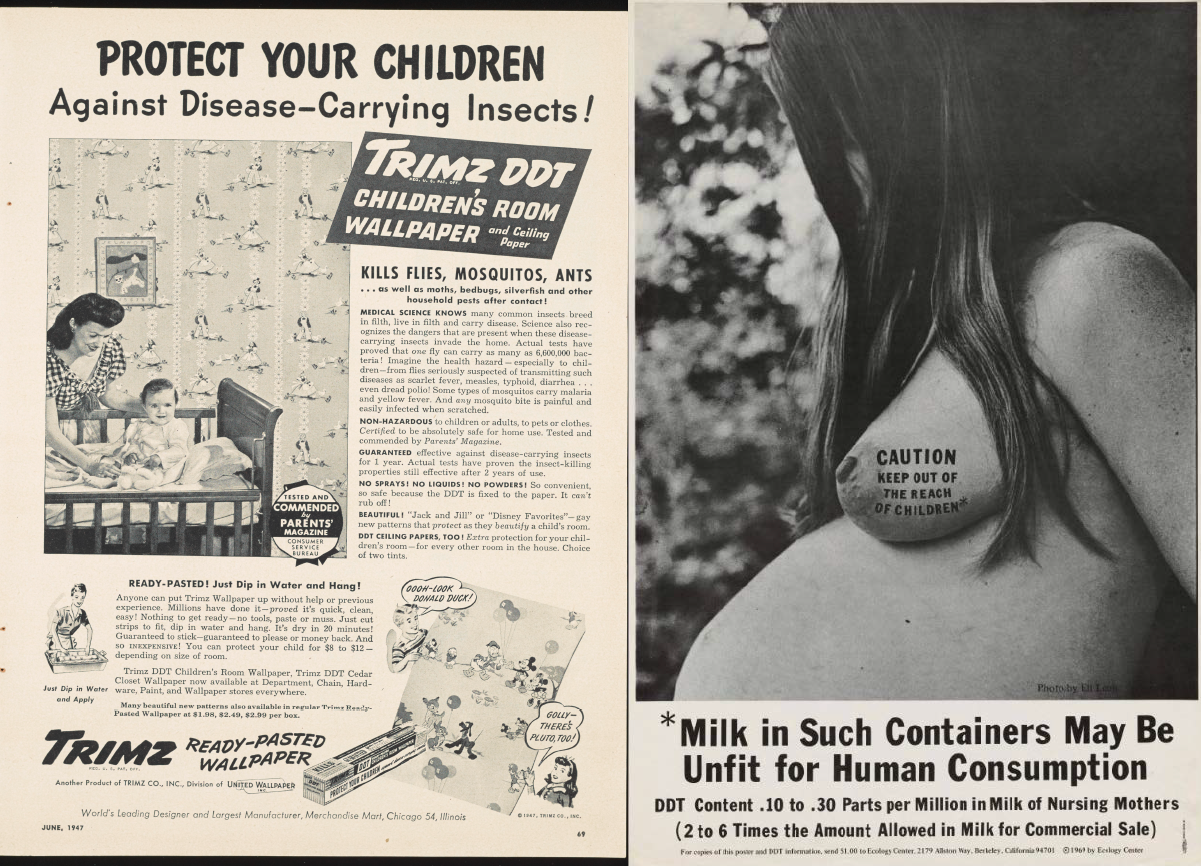
How can we learn more about science in our daily lives, interpret science history, and reflect on inclusive science? One example of how to approach this process is to reflect on the history of DDT.[7] In 1939, research showed DDT was an insecticide, useful to eradicate insects transmitting human diseases such as typhus (lice) and malaria (mosquitoes). By 1945, DDT was commercially available in the United States. Advertised as the “benefactor of all humanity,” DDT was used to control insects that negatively affected human, animal, and plant health. Then, in 1962 biologist Rachel Carson published Silent Spring. She showed that DDT persisted in the environment, working its way up the food chain and accumulating in fatty tissues—including human milk—with devastating effects, thus launching the environmental movement. DDT was a beneficial chemical that became detrimental.[8] From a “Futures Literacy” perspective, the history of DDT prompts us to learn and understand scientific facts, unpack social perceptions about science in our everyday lives, and recognize historical contingency.[9]
Working with Primary Sources
Historians have an essential role in exploring the science of the past and helping individuals reflect on, and critically frame, present-day perceptions of science. By their nature, history museums cross disciplines. The Library of Congress website “Teaching with Primary Documents” is useful to begin using everyday objects to address inclusive history.[10] For example, the “Everyday Mysteries” site asks: “How did squash get its name?” We learn that the English word “squash” is derived from “askutasquash,” meaning “eaten raw or uncooked” in the Narragansett language.[11]
Inclusive history would include examples of Indigenous science and knowledge such as the “three sisters” food system whereby corn (maize), beans, and squash were planted together.[12] The corn supported the bean vines, the squash served as a cover crop to retain soil moisture, and bean roots formed nodules of nitrogen-fixing soil bacteria to enhance plant growth. The outcome: a meal of corn, beans, and squash provided a nearly nutritionally complete diet; the addition of chiles (peppers) provided the necessary requirement of vitamin C. Thus, we find history and science imbued within seeds. Indigenous knowledge stresses that recognizing the complementarity of the “three sisters”—or companion planting—merely touches the surface of the complexity of local expertise tied to food security and resource management.[13]
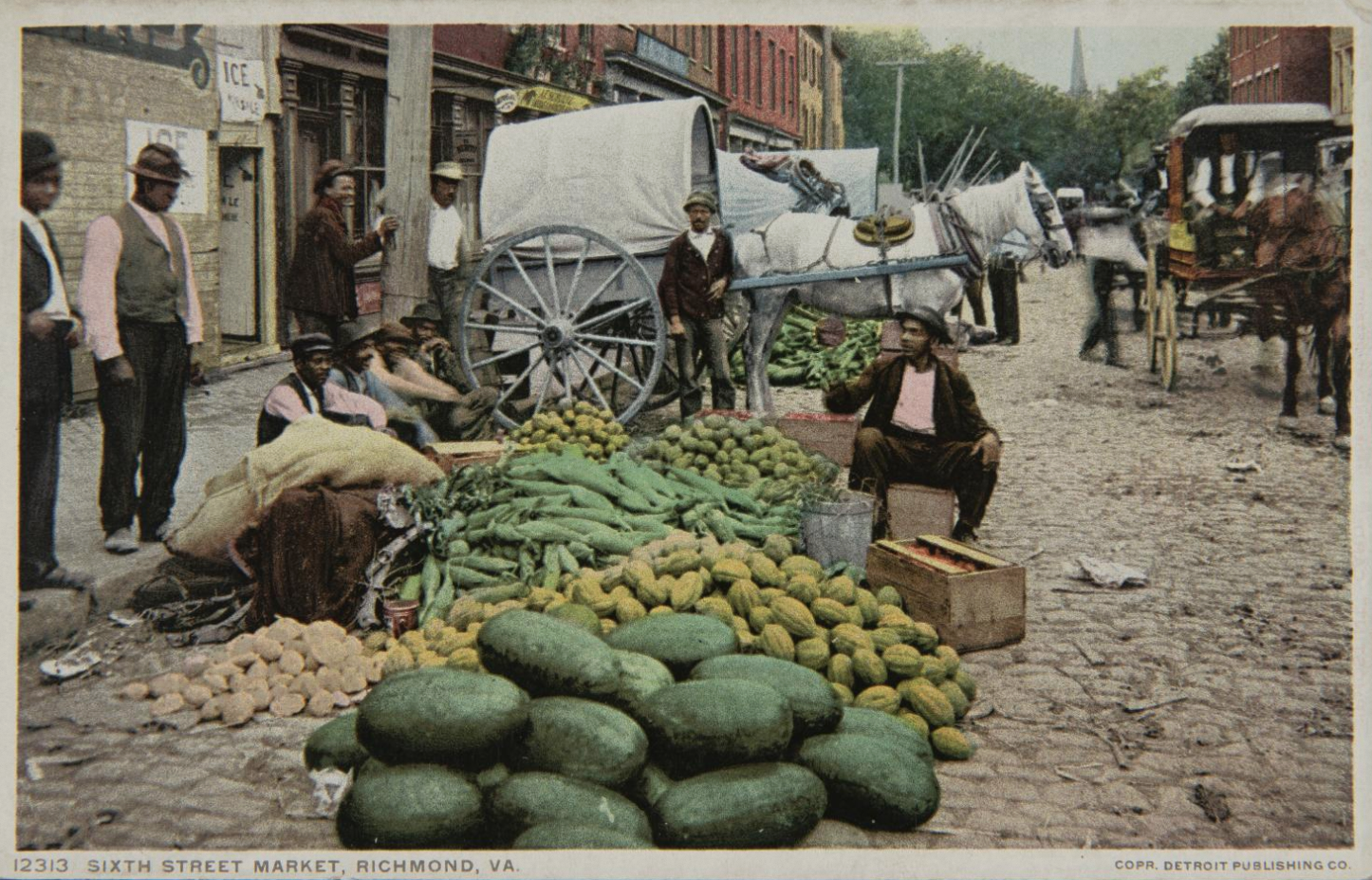
Seed catalogs and seed packets, and garden diaries and recipes, also are primary source materials. From these resources, launch a conversation about plant selection and seed saving, including the Svalbard Global Seed Vault (the “doomsday” seed bank in Norway), diet and health, water and land rights, and the religious and cultural meanings attributed to plants. Each of these topics is a potent reminder that foods and cooking are superb tools to integrate science and inclusive (community) history.[14]
Interactive websites with tutorials about specific sciences and an emphasis on the scientific method are especially welcome when they have English and Spanish materials for young learners. One example is the Florissant Fossil Beds National Monument site with bilingual activities and videos. Photographs of fossilized plants, fish, and insects provide primary source material. The site also explains the importance of these fossils in studying climate change and the evolution of plants and animals. Continuing with the fossil theme, the Library of Congress has materials to explore controversy and ethics in science and discusses how to use primary sources to explain the process of fossilization.
Interpreting Science at Your Site
A framework for interpreting science through an inclusive historical lens includes: 1) identifying an object in a collection that will facilitate interest in science or a scientist; 2) asking how science and scientists both construct and challenge social inequities related to the object; and 3) determining how the object can be used to facilitate citizen science—or community science—to bridge the practices of history and science.
- Identifying and interpreting documents and material culture in museum collections.
Pick an object in a collection, an archive, or outdoors; observe the object; and think (or learn) about its history. If you are interested in climate change, then personalize it by making use of local historical records and observations of temperature and precipitation. These local records become tools for scientists and historians when we ask about outcomes over time. The negative effects of climate change are evident and escalating rapidly, and, consequently, a pressing question is, how did climate affect humans historically? A cooperative effort between humanists, scientists, and museum guests can lead to myriad answers to this question. One valuable resource to integrate climate into an inclusive history is the U.S. Climate Resilience Toolkit, which includes a practitioner’s guide, case studies on social equity, and climate-related risk assessments.[15]
Historians of science Sam White and Roger Turner demonstrate this approach in their essays in Interpreting Science at Museums and Historic Sites.[16] White’s focus is using tree rings as data points to build historical and environmental timelines. Tree rings are a powerful tool to reveal change over time. Turner has shown how a single collection of weather data over decades can personalize the history and science of climate change.
- Asking how science and scientists both construct and challenge social inequities related to the object.
In the United States, weather is a daily topic of conversation and an ideal stepping off point for a history and science project. Daily living, manufacturing, recreation, and politics interface with the science of weather, both today and across the decades and centuries. The National Centers for Environmental Information’s “Past Weather,” a part of the National Oceanic and Atmospheric Administration (NOAA), documents daily high/low temperatures and precipitation throughout the United States, with some of the records dating to the mid-nineteenth century.[17] Mention of creeks and areas subject to flooding can be studied with old plat maps, and topographical maps can be used to understand how and why waterways were rerouted or lost over time.
This data informs our historical understanding of how temperature, wind, and precipitation determine why people settle in (or leave) a particular area. The incidence of insects and varmints, animal and crop losses, or disease as recorded in newspapers, diaries, and farm records may be better understood through the lens of scientific (weather) data.
- Citizen science, or community science: Bridging the practices of history and science.
Citizen science—or community science—is a participatory strategy to have the public collect data as part of large, collaborative projects.
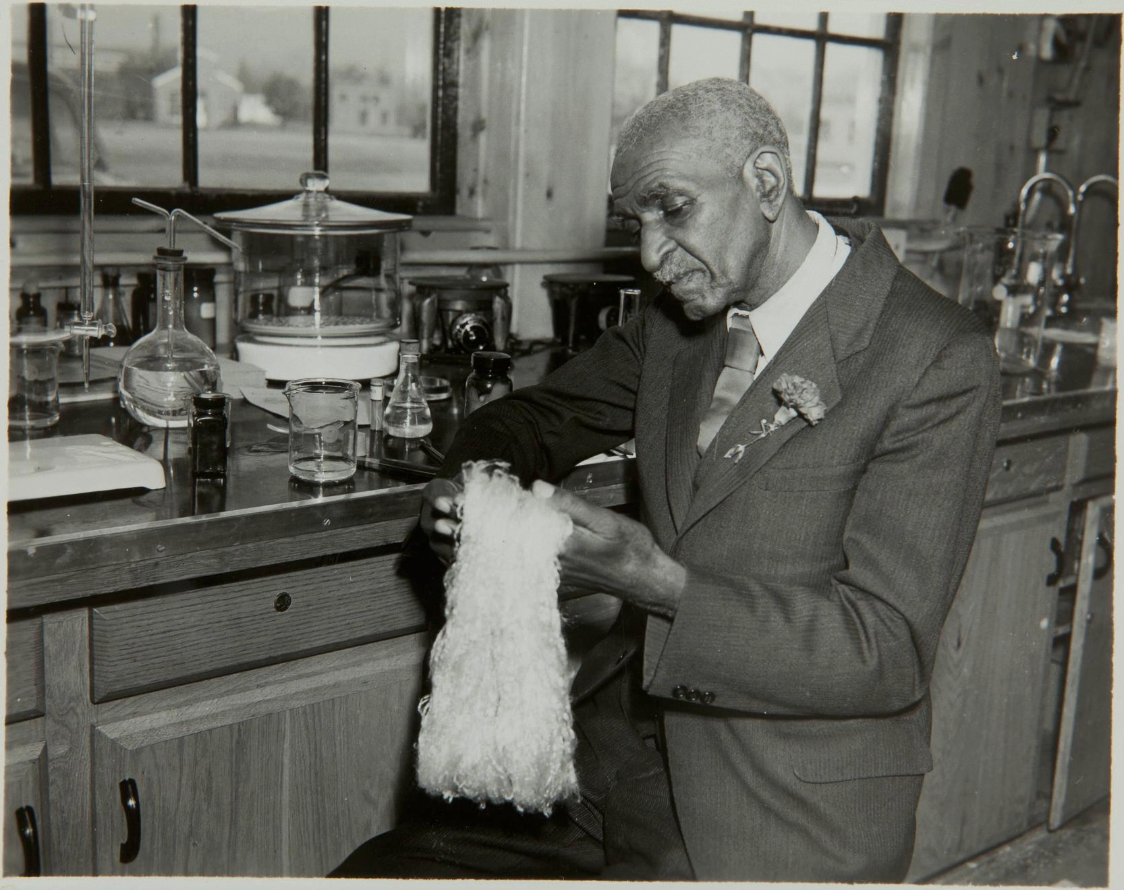
George Washington Carver —the African American scientist, artist, and innovator—had pertinent advice for the citizen-scientist.[18] Carver wrote of the need for scientists to be outside to observe, first by drawing, then by writing, and then interpreting.[19] His suggestions, made more than a century ago, to practice observation and interpretation as the basis for scientific investigations remain relevant today. Humans are by nature curious; what we need is permission to observe. Use what is at your site—for example, thermometers, a bird identification book, almanacs, photographs, and journal or diary entries—to make comparisons between earlier observations and knowledge today. Observing, drawing, conversing, and asking questions serve as a conduit to the past and cross-cultural learning. A focus on observing can open vistas to thinking more deeply and broadly about science and its meaning in our world.
For formal citizen science projects, individuals collect data as part of large collaborative projects—everything from watching clouds on Mars to cataloging insects. (More than 500 community science projects are hosted at https://www.citizenscience.gov/.) Nature’s Notebook is another application used to record observations about plants and animals for natural resource decision-making and planning as we are increasingly affected by climate change.[20] Established in 2013, the Colorado Butterfly Monitoring Network is one example.[21] Observers are trained to identify and collect butterflies, walking a short trail every week from May until first frost (about six months). The data is collated and publicly available. National and international community science projects use iNaturalist and Merlin Bird ID. The gamification of some community science apps has resulted in the collection of millions of geographic data points that are used for scientific reports and policy papers.
Public engagement using science can educate and excite the visitor to make more informed decisions about their place in the world.[22] Knowledge of the scientific process and how science has influenced our world can produce fruitful conversations across disciplines—hopefully putting some STEAM into STEM by adding the Arts.[23] The strongest approach to studying the past engages human interests. This focus is based on historical materials and reinterpretation using local data and developing critical thinking skills. The process of observation and interpretation allows all of us to become better informed about rapid changes in science and how we understand our world today.
Conclusion
The practice of science is a process of interpreting and understanding the natural world. This method is fundamentally one of asking questions, testing the questions through experimentation, and interpreting and communicating the results.
Historical analyses of science and scientific outcomes are possible even with limited resources. Science demands historical interpretation and analysis of how it influences our lives—and how society influences scientific study. Science is entwined within our everyday lives and almost every cultural object serves as a point of entry for interpretation. An exploration of how communities have been and are affected by science allows for deeper conversations about our twenty-first century world
Notes
[1] For an example of using a kitchen tool to interpret science, see: Karen-Beth G. Scholthof and Debra A. Reid, “Science and Progress in the Kitchen: Forks, Eggbeaters, and Sporks,” in Interpreting Science at Museums and Historic Sites, edited by D. A. Reid, K.-B.G. Scholthof, and D. D. Vail (Bloomsbury, 2023), 130-136.
[2] Walter E. Massey, “C. P. Snow and the Two Cultures, 60 Years later,” European Review 27 (2019): 66-74; C. P. Snow, The Two Cultures and the Scientific Revolution (Cambridge University Press, 1959), https://ia801008.us.archive.org/15/items/snow_1959/snow_1959_text.pdf.
[3] Bethann Garramon Merkle, “Integrating Art and Science to Effectively Share Knowledge,” in Interpreting Science at Museums and Historic Sites, 137-147.
[4] Paul A. Lombardo, “‘Ridding the Race of His Defective Blood’—Eugenics in the Journal, 1906–1948,” New England Journal of Medicine 390 (2024): 869-873, https://doi.org/10.1056/NEJMp2307346; “The History of Vaccines,” The College of Physicians of Philadelphia, https://historyofvaccines.org/; “The Vaccine Integrity Project,” Center for Infectious Disease Research and Policy (CIDRAP), University of Minnesota, https://vaxintegrity.cidrap.umn.edu/; “Global Climate Change,” Smithsonian, Washington, DC, https://www.si.edu/explore/science/climate-change.
[5] “History’s Habits of Mind,” National Council for History Education, https://ncheteach.org/resources/historys-habits-of-mind/.
[6] “Futures Literacy & Foresight,” UNESCO, https://www.unesco.org/en/futures-literacy; Jan Erik Karlsen, “Futures Literacy in the Loop,” European Journal of Futures Research 9 (2021): 17, https://doi.org/10.1186/s40309-021-00187-y.
[7] DDT is the chemical dichlorodiphenyltrichloroethane.
[8] Elena Conis, “Beyond Silent Spring: An Alternate History of DDT,” Distillations Magazine, Science History Institute, February 14, 2017, https://www.sciencehistory.org/stories/magazine/beyond-silent-spring-an-alternate-history-of-ddt/.
[9] “Yale Experts Explain PFAS ‘Forever Chemicals,” Yale University Office of Sustainability, May, 2025, https://sustainability.yale.edu/explainers/yale-experts-explain-pfas-forever-chemicals.
[10] “Teaching with Primary Sources Partner Program,” Library of Congress, https://www.loc.gov/programs/teachers/about-this-program/teaching-with-primary-sources-partner-program/.
[11] “Everyday Mysteries: Fun Science Facts from the Library of Congress,” Library of Congress, https://www.loc.gov/everyday-mysteries/agriculture/item/how-did-squash-get-its-name/.
[12] “Native Life and Food: Food Is More Than Just What We Eat,” Native Knowledge 360º, National Museum of the American Indian, Smithsonian, Washington, D.C., https://americanindian.si.edu/nk360/informational/native-life-food.
[13] Sean Sherman, Kate Nelson and Kristin Donnelly, Turtle Island: Foods and Traditions of the Indigenous Peoples of North America (Clarkson Potter, 2025); and, David E. Stuart, Ancient Women Gardeners: Prelude to the Chacoan World (University of New Mexico, 2025).
[14] Cooking and food preparation reflect our understanding of science and provide an easy entry into the “how to” of the scientific method, as shown by Harold McGee’s On Food and Cooking, Camille Dungy’s Soil, Sean Sherman’s Turtle Island, and Alice Waters’s “Edible Schoolyard Project.”
[15] U.S. Climate Resilience Toolkit, https://toolkit.climate.gov/.
[16] Roger Turner, “Local Weather, Distant Connections: Interpreting Meteorological Instruments and Data,” in Interpreting Science at Museums and Historic Sites, 22-30; and, Sam White, “Communicating Climate Change with Archives of Nature and Archives of Societies,” in Interpreting Science, 1-8.
[17] “Past Weather,” NOAA, https://www.ncei.noaa.gov/access/past-weather/.
[18] “What If an Artist Becomes a Scientist,” The Henry Ford, https://www.thehenryford.org/explore/stories-of-innovation/what-if/george-washington-carver/. For a precise explanation of Carver’s science see “George Washington Carver National Historic Chemical Landmark,” American Chemical Society, January 27, 2005: https://www.acs.org/education/whatischemistry/landmarks/carver.html.
[19] George Washington Carver, Progressive Nature Studies, Tuskegee Institute Print (1897).
[20] Nature’s Notebook, National Phenology Network, https://www.usanpn.org/nn. Phenology is the science of recording first dates of biological events, such as tree budbreak, first day of flowering, or arrival of birds. These data have been used by historians and scientists to document local climate change. For example, in the United States, the recorded observations of Henry David Thoreau and Aldo Leopold have been key in our understanding of how climate is driving biological changes. See: Elizabeth R. Ellwood, Amanda S. Gallinat, Caitlin McDonough MacKenzie, Tara Miller, Abraham J. Miller-Rushing, Caroline Polgar, and Richard B. Primack, “Plant and Bird Phenology and Plant Occurrence from 1851 to 2020 (non-Continuous) in Thoreau’s Concord, Massachusetts.” Ecology 103 (2022): e3646. https://doi.org/10.1002/ecy.3646; and, Aldo Leopold and Sara E. Jones, “A Phenological Record for Sauk and Dane Counties, Wisconsin, 1935-1945,” Ecological Monographs, 17 (1947): 81-122. https://www.jstor.org/stable/1948614.
[21] Colorado Butterfly Monitoring Network, Butterfly Pavilion, Westminster, CO, https://butterflies.org/research-and-conserve/butterfly-monitoring/.
[22] Karen-Beth G. Scholthof, “Preface,” in Interpreting Science at Museums and Historic Sites, xv-xxiv.
[23] Reading Henry David Thoreau’s Walden and Camille Dungy’s Soil: The Story of a Black Mother’s Garden makes evident the delightful links between the sciences and the humanities. Additional books to consider within the science/humanities continuum are Susan Fenimore Cooper’s Rural Hours (1850), Aldo Leopold’s The Sand County Almanac (Oxford University Press, 1949), and Alison Hawthorne Deming’s Science and Other Poems (Louisiana State University, 1994).
Suggested Readings
Examples of Popular Science Books
Dungy, Camille. Soil: The Story of a Black Mother’s Garden. New York: Simon & Schuster, 2023.
Isaacson, Walter. The Code Breaker: Jennifer Doudna, Gene Editing, and the Future of the Human Race. New York: Simon & Schuster, 2022.
McGee, Harold. Nose Dive: A Field Guide to the World’s Smells. New York, Penguin, 2022.
Philip, Leila. Beaverland: How One Weird Rodent Made America. New York, Twelve, 2022.
Sherman, Sean, Kate Nelson, and Kristin Donnelly. Turtle Island: Foods and Traditions of the Indigenous Peoples of North America. New York, Clarkson Potter, 2025.
Shetterly, Margot Lee. Hidden Figures: The American Dream and the Untold Story of the Black Women Mathematicians Who Helped Win the Space Race. New York, HarperCollins, 2016.
Simard, Suzanne. Finding the Mother Tree: Discovering the Wisdom of the Forest. New York, Knopf Doubleday, 2021.
Yong, Ed. I Contain Multitudes: The Microbes Within Us and a Grander View of Life. New York, Random House, 2016.
Science Journalism, Listening, and Viewing
Best American Science and Nature Writing. New York, Mariner.
Knowable Magazine, https://knowablemagazine.org/
Distillations Podcast, Science History Institute Museum and Library, https://www.sciencehistory.org/stories/distillations-pod/
Smithsonian Magazine, https://smithsonianmag.com
National Public Radio Science Podcast Directory, https://www.npr.org/podcasts/2047/science
“Nature” Podcast, Nature, https://www.nature.com/nature/articles?type=nature-podcast
“Science” Podcast, Science, American Association for the Advancement of Science, https://www.science.org/podcasts
“World Science Festival” Video Library, https://www.worldsciencefestival.com/video/video-library/
Resources for Historians
McNeill, John R., and Peter Engelke. The Great Acceleration: An Environmental History of the Anthropocene since 1945. Cambridge, MA: Harvard University Press/Belknap, 2014.
Reid, Debra A. Interpreting Agriculture at Museums and Historic Sites. Lanham, MD: Rowman & Littlefield, 2017.
Reid, Debra A. , and David D. Vail. Interpreting the Environment at Museums and Historic Sites. Lanham, MD: Rowman & Littlefield, 2019.
Reid, Debra A., Karen-Beth G. Scholthof, and David D. Vail. Interpreting Science at Museums and Historic Sites. Lanham, MD: Rowman & Littlefield, 2023.
Sutton, Sarah. The Arts and Humanities on Environmental and Climate Change: Broadening Approaches to Research and Public Engagement. New York: Routledge, 2022.
White, Sam, Christian Pfister, and Franz Mauelshagen, eds. The Palgrave Handbook of Climate History; Routledge Handbook of Environmental History. New York: Palgrave Macmillan, 2018.
Authors
Debra A. Reid is Curator of Agriculture and the Environment at The Henry Ford and professor emerita at Eastern Illinois University, Department of History. She studied cultural geography at the undergraduate and PhD levels. Her historical research focuses on rural and minority cultures and Black farm owners among other topics. She is a fellow of the Agricultural History Society and recipient of distinguished service awards from the Association for Living History, Farm and Agricultural Museums and from the Agricultural History Society.
Karen-Beth G. Scholthof is professor emerita at Texas A&M University, Department of Plant Pathology and Microbiology. As a plant virologist, she researched the molecular biology of host-virus interactions. Her historical research includes the historiography of tobacco mosaic virus, and the social, environmental and scientific influences of plant pathogens. She is a fellow of the Agricultural History Society, the American Academy of Microbiology, the American Association for the Advancement of Science, and the American Phytopathological Society.
